
Cami Tuttle stroke survival story
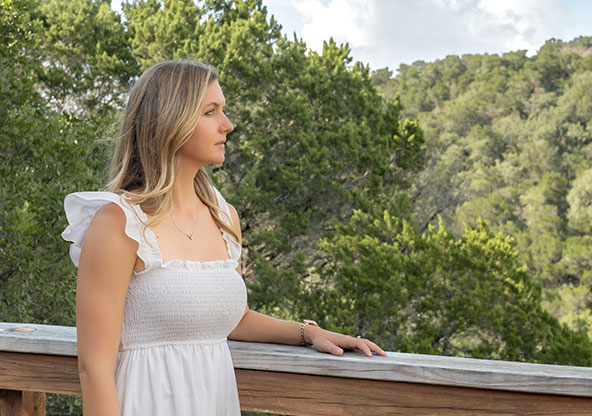
At 34 years old, Cami Tuttle was a busy wife, mother of three young daughters and labor and delivery nurse with CHRISTUS Health. A stroke was the last thing she expected.
Then, in the middle of the night, Cami woke with weakness on the left side of her body. At first, she wondered whether she had simply slept on her side wrong. But as she tried to move, she realized something was different.
Her husband noticed that her face was drooping and her speech had changed.
“In my mind, I was like, ‘I’m having a stroke,’” Cami recalled.
The symptoms disappeared within minutes, leaving Cami struggling to understand how something so serious could be happening to someone her age.
“Why would an otherwise healthy 34-year-old woman have stroke-like symptoms?” she said.
What followed would take Cami through multiple CHRISTUS Health facilities, introduce her to a team of specialists and ultimately bring her back home to the three girls who remained at the center of every decision she made.
A Second Emergency Changes Everything
The next morning, Cami contacted her primary care provider, Dr. Mariel Bagley, who was working at a CHRISTUS Trinity Clinic location that day. Because Bagley had known Cami for years, she immediately noticed that Cami’s face was still drooping and directed her to emergency care.
Cami went to the CHRISTUS emergency department in San Marcos, where she underwent imaging and was kept overnight. She was later discharged on blood thinners.
But Cami had only been home about an hour when an intense headache suddenly came on. The weakness returned. Her vision became blurry. Her speech became slurred.
This time, Cami knew something was seriously wrong.
“This is it. This is a real stroke,” she remembered thinking.
Her husband rushed her to the CHRISTUS emergency department in New Braunfels. The care team determined that Cami was experiencing bleeding in her brain, and she was quickly transferred to the neuro ICU at CHRISTUS Santa Rosa Hospital – Westover Hills for a higher level of neurological care.
Searching for an Answer
Ryan Morton, MD, a CHRISTUS Health neurosurgeon specializing in cerebrovascular and endovascular neurosurgery, became part of Cami’s care team.
According to Dr. Morton, Cami initially experienced an ischemic stroke, in which blood flow was interrupted to part of the brain. She then experienced a rare hemorrhagic conversion, meaning bleeding developed in the area of the stroke.
But something about her scans did not look typical.
A diagnostic angiogram gave the team the answer: Cami had developed a rare dissecting pseudoaneurysm in a very small blood vessel in the brain.
“The risk was that this aneurysm was going to bleed again if we didn’t get it fixed,” Dr. Morton said.
The location made treatment especially challenging. The artery was extremely small and supplied an area of the brain responsible for movement. Treating the aneurysm meant navigating a delicate balance: reaching it without damaging the surrounding blood vessel or interrupting blood flow to other critical areas of the brain.
Dr. Morton and the team initially gave the aneurysm time to potentially resolve on its own. When repeat imaging showed that it remained, another important change had occurred: it was now accessible for treatment.
For Cami and her husband, that opened the door to hope.
Trusting the Team in a High-Stakes Moment
Cami understood enough about health care to recognize the seriousness of the situation. As a nurse herself, some of the medical language carried an added weight.
But she also felt a deep sense of confidence in the team caring for her.
“I felt confident in the doctors that the Lord had put in front of us,” Cami said. “And I felt confident in the Lord.”
After multiple conversations with Dr. Morton, Cami and her husband decided to move forward with the procedure.
“We were just so thankful that he was there and his timing in that unit, and that he has dedicated his career to perfecting these skills,” Cami said.
Dr. Morton used a minimally invasive endovascular approach to navigate a catheter through Cami’s blood vessels and into the tiny artery containing the aneurysm. A specialized catheter with an especially small tip had been brought in specifically for her case.
Once he reached the aneurysm, Dr. Morton placed a one-millimeter coil designed to seal the aneurysm while preserving blood flow through the surrounding vessel.
The procedure was completed without complications.
For Dr. Morton, the outcome represented far more than a successful image on a scan.
“It’s not only just making the pictures look good, but it’s having that patient have the good outcome that really is impactful and meaningful,” he said.
Cami underwent the coiling procedure on April 3. The following day, she went home.
One Patient, One Connected CHRISTUS Health Team
Cami’s journey touched several parts of CHRISTUS Health, from primary care to emergency services in San Marcos and New Braunfels to highly specialized neurological care at Westover Hills.
Across Texas, patients can access advanced stroke care at three CHRISTUS Health locations. CHRISTUS Santa Rosa Hospital – Westover Hills in San Antonio is designated as a DNV Comprehensive Stroke Center, with advanced neurointerventional and neurosurgical care.
That connection mattered.
When Cami arrived at different CHRISTUS facilities, teams were able to see imaging that had already been completed and understand how her condition had progressed.
Dr. Morton said the system allows specialists to review images from other CHRISTUS hospitals, communicate directly with providers and begin planning care even before a patient arrives.
“As soon as there’s a stroke alert, I get the images on my phone,” he said. “I can speak to the providers at the other hospital. We can make sure that the care is streamlined, the transfer streamlined.”
For stroke patients, reducing unnecessary delays is critical.
Roxy Luna, administrative director of nursing for the neuro ICU and neuro IMC at CHRISTUS Health, said caring for a stroke patient requires far more than the work of a single physician or department.
“It is truly a collaborative team effort,” Luna said.
Emergency care, imaging, neurosurgery, neurology, nursing, radiology, pharmacy, physical therapy and case management can all play roles throughout a patient's hospitalization and recovery.
Luna said CHRISTUS teams also work closely with sister hospitals in San Marcos and New Braunfels to review transfers, identify opportunities and continually improve stroke care.
“We want to be there for our community and make sure that we’re taking care of our patients here at home,” she said.
Receiving Comprehensive Stroke Care
Cami received treatment at CHRISTUS Santa Rosa Hospital – Westover Hills, which is now designated as a DNV Comprehensive Stroke Center. The designation recognizes the hospital’s ability to provide advanced treatment for even the most complex strokes, including around-the-clock access to neurological specialists, neurosurgery and advanced procedures.
For patients and families, that means more stroke treatment can happen right here in San Antonio instead of requiring a transfer to another hospital.
“Previously, we had to transfer these patients out to another facility to perform these highly complex interventions,” said Luna. “But now we’re able to treat these patients here in our hospital, which is great for our community. We’re able to see them quicker and intervene quicker.”
Providing that level of treatment requires more than specialized technology. Luna said the hospital must have 24/7 access to specialized physicians and nurses who complete specific stroke education each year. New technology also allows the team to view the brain from multiple angles during complex procedures.
“Being able to do these procedures immediately reduces delays in care,” Luna said. “It provides better outcomes for our patients as well.”
Dr. Morton said around-the-clock neurointerventional capabilities, neurological surgery and a dedicated neurological intensive care unit are among the most important requirements of a comprehensive stroke center.
“Being able to support that 24/7 is the hallmark of being a comprehensive stroke center,” Morton said.
For people on San Antonio’s west side, the designation means advanced stroke treatment is available closer to where they live. The hospital became the first Comprehensive Stroke Center on San Antonio’s west side in September 2026.
And that advanced stroke network extends across Texas. CHRISTUS Spohn Hospital Corpus Christi – Shoreline serves South Texas as a Level I Stroke Center while CHRISTUS Mother Frances Hospital – Tyler serves Northeast Texas as a Level I Stroke Center.
More Than a Patient
For Cami, one of the things that stood out most was the compassion surrounding that expertise.
“They were fantastic,” she said of her CHRISTUS Health care team. “We didn’t meet a single one that we didn’t have our full confidence in.”
But what affected her most deeply was knowing that her caregivers saw more than a diagnosis.
“They knew that I was a wife and a mother and a daughter and a sister,” Cami said.
Her husband never left her side. Meanwhile, Cami’s parents stepped in to care for her daughters. Their school, neighbors and friends offered help with meals, transportation and daily routines so life could remain as normal as possible for the girls while their mother was hospitalized.
“We have never seen more support than we had seen,” Cami said. “We were never more thankful to the community that we had.”
Through it all, Cami’s daughters remained her greatest motivation.
“I just kept saying, I can’t go home not knowing if I’ll have a stroke again,” she said.
She did not want her illness to become the defining story of their childhood.
“That’s not my kids’ story,” she said.
Coming Home to What Matters Most
When Cami finally returned home, the reunion was joyful but tender.
Her daughters were initially hesitant. They knew their mom had been hurt and were unsure whether they could sit with her or touch her the way they had before.
Recovery also took patience.
Cami continued physical and speech therapy and struggled with low energy and swallowing difficulties. Gradually, however, her strength returned.
By the time she shared her story, Cami had completed speech therapy, returned to her work at the hospital and resumed working in real estate.
Most importantly, she was keeping up with her daughters again.
“I have energy to keep up with the kids,” she said.
Family life once again includes sports, swimming, playing near the creek at home and simply being together.
Those ordinary moments no longer feel ordinary to Cami.
“I’m a very emotional human now,” she said. “I cry at the drop of the hat. It’s like, you know, because everything just means so much more.”
Proud to Care and Grateful to Be Cared For
Cami had already spent years caring for others as a CHRISTUS Health nurse. Becoming a patient allowed her to see the organization from a different perspective.
“After being a patient there and seeing the extents they’ll go to to help their patients, it just makes me feel really proud to be a part of that system,” she said.
Her experience also strengthened something that had long mattered to her: the connection between faith and healing.
Cami said she values being part of a faith-based health system where caregivers can recognize the emotional and spiritual needs of patients alongside their medical needs.
“I think we heal the whole person, not just treat the symptoms at CHRISTUS,” she said.
And when asked what she would tell the people who helped give her the opportunity to return home to her husband, daughters and life she loves, her message was simple.
“Thank you, of course,” Cami said. “And just keep doing what you’re doing. It matters.”
Know the Signs. Act Fast.
Cami never expected to experience a stroke at 34. Her experience is also why she encourages others not to ignore possible stroke symptoms.
“Just acting fast is very important,” she said.
Dr. Morton echoed that message, emphasizing the importance of recognizing sudden neurological symptoms and seeking emergency care rather than waiting for them to pass.
When stroke symptoms appear, every moment matters.
If you or someone around you experiences signs of a stroke, call 911 immediately.
Learn more about stroke care and neurological services available through CHRISTUS Health.
